

Achilles Tendon Repair
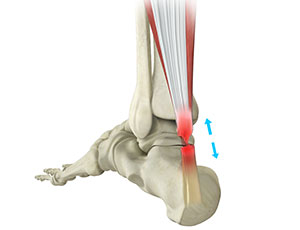
What happens when the Achilles ruptures
The Achilles is the largest and strongest tendon in the body. It connects the calf muscles to the heel bone, and it is what lets you push off to walk, run, and jump. A rupture usually happens suddenly during a change of direction or a push-off — many people describe feeling struck in the back of the leg and turning around to see who did it, followed by a pop and the inability to push off.
Once torn, the ends separate and the calf loses its connection to the heel. Walking is possible but weak and flat-footed, and rising onto the toes on that leg is not.
Repair or treat it without surgery?
Both are legitimate. A rupture can be treated in a cast or boot, holding the ankle pointed down so the torn ends sit together and heal, and results with a well-run non-surgical protocol are good. Surgical repair is generally favoured for younger and more active patients, for those whose work or sport demands full push-off strength, for delayed presentations where the ends have drawn apart, and for re-ruptures.
Diabetes, smoking, and problems with the skin over the tendon raise the risk of wound complications and are weighed carefully in that decision — they make the conversation more careful, not automatically non-surgical.
The operation
Repair is usually done as an outpatient procedure through an incision at the back of the leg. The torn ends are brought together and held with strong sutures; if the tendon has pulled off the heel bone, it is reattached to the bone directly. Where tendon quality is poor or the rupture is old, the repair may be reinforced.
Recovery
Recovery is deliberately staged, and the pace matters more here than in almost any other foot and ankle operation. Advancing too quickly is the most common cause of re-rupture.
You will leave surgery in a well-padded splint with the ankle pointed slightly down, and you will keep all weight off that leg. At two weeks the splint comes off and you move into a walking boot with heel wedges, which are removed one at a time each week to bring the ankle gradually back to neutral. The boot is worn whenever you are up and moving, and while sleeping, until eight weeks.
Physical therapy runs alongside it. From two to six weeks the focus is range of motion within safe limits, isometric calf work, and swelling control — with no passive stretching of the ankle past neutral. From six to twelve weeks, weight bearing progresses, you transition into a regular shoe around eight to ten weeks, and the work shifts to balance and eccentric calf strengthening, which is the key exercise for a healing tendon.
If you have a desk job you can return to work once you can get there safely. Physical work is realistically three months out, with restrictions. You will receive a written protocol covering each stage.
Complications of Achilles Tendon Repair
As with all surgical procedures, Achilles tendon repair may be associated with certain complications such as infection, bleeding, nerve injury, and blood clots.