

Ankle Arthrodesis
Ankle Arthrodesis (Ankle Fusion)
Ankle fusion treats end-stage ankle arthritis by removing the worn joint surfaces and holding the bones together until they heal into one. Benjamin R. Williams, MD performs both ankle fusion and ankle replacement, and will discuss which suits your ankle.
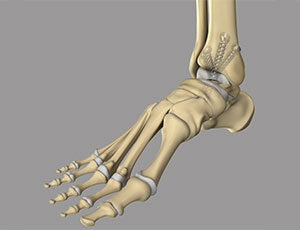
What fusion does
Ankle fusion treats end-stage arthritis by removing the worn-out joint surfaces and holding the shin bone and the talus together, with screws or a plate, until they heal into one continuous bone. Once the joint no longer moves, the arthritic surfaces can no longer grind against each other, and the pain that came from that grinding stops.
It is a durable operation with a long track record. What it costs you is the up-and-down motion of the ankle itself.
Fusion or replacement?
This is the real decision, and both operations are good ones. Fusion gives up ankle motion in exchange for durability, which makes it well suited to patients who are younger and heavier, who work physically, whose ankle sits in significant deformity, whose bone quality is poor, or who have had infection or a failed replacement. Replacement preserves motion, which tends to feel more natural walking and asks less of the joints around the ankle over time.
The trade-off with fusion is that the joints below the ankle take on the work it no longer does, and over the years some patients develop arthritis in those joints. Which operation suits you depends on your alignment, bone quality, activity, and what you need the ankle to do — a conversation worth having in person, with your imaging in front of you.
What the operation involves
Depending on your alignment and the amount of deformity, fusion can be done arthroscopically through small portals or through an open incision at the front or the side of the ankle. In either case the remaining cartilage is removed down to healthy bleeding bone, the ankle is positioned in the alignment that will serve you best for walking, and it is held there with screws, a plate, or both.
Where there is a gap or significant bone loss, bone graft is used to fill it — taken either from you or from donor tissue.
Recovery
Fusion depends entirely on bone healing, so you will keep weight off the ankle in a splint and then a cast or boot until X-rays show the bone has united. That takes longer than most people expect, and smoking meaningfully reduces the chance of the fusion healing.
Once fused, most people walk comfortably on level ground and are surprised how normal it feels. Uneven ground, slopes, and stairs take more adaptation, and a rocker-soled shoe helps some patients. You will receive a written protocol setting out each stage.
What are the Risks and Complications of Ankle Arthrodesis Surgery?
Ankle arthrodesis is usually a safe procedure and complications are uncommon. However, apart from general complications related to any surgery, complications after ankle arthrodesis can include infection, nerve damage, unresolved pain, non-union of bones, excessive swelling and stiffness, and irritation from foreign material such as pins or screws.