

If your injury just happened
TRIA offers walk-in orthopedic urgent care at 8100 Northland Dr in Bloomington, the same building as Dr. Williams's office. No appointment is needed and it is open seven days a week. If you have had a sudden injury and are not sure whether it needs an X-ray, that is usually the fastest way to get an answer, and you will be seen by a musculoskeletal specialist. Check current urgent care hours, then call (952) 831-8742 to arrange follow-up with Dr. Williams.
Ankle Fractures
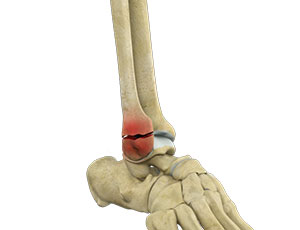
What breaks, and why it matters
The ankle is a ring: the tibia and fibula form a socket that grips the talus, held together by ligaments. A fracture can involve the outer bone (the fibula), the inner bone (the medial malleolus), the back of the tibia, or a combination — described as bimalleolar or trimalleolar depending on how many parts are broken.
What determines treatment is not simply which bones are broken but whether the talus still sits centred in its socket. The ankle tolerates displacement very poorly; even a small shift concentrates load onto a fraction of the joint surface and leads to arthritis years later. Restoring that alignment is the whole point of treatment.
Diagnosis
X-rays taken in several views establish which bones are broken and whether the joint is aligned. Stress views or weightbearing X-rays are sometimes added to reveal instability that is not obvious on a resting film. CT is used for fractures involving the back of the tibia or the joint surface, where the detail changes the surgical plan.
Treatment without surgery
A fracture that is stable and in good position can be treated in a boot or cast. That means the joint stays aligned when the ankle is loaded, which is why a stability assessment matters. These fractures are followed with repeat X-rays during the early weeks, because a small number shift and declare themselves late.
Surgery
Fractures that are displaced or unstable are treated with open reduction and internal fixation: the bone fragments are put back into anatomic position and held there with plates and screws while they heal. Where the ligaments between the tibia and fibula have been disrupted, that relationship is stabilized as well.
The hardware is generally left in place permanently and causes no problems. If it becomes prominent or painful, it can be removed once the fracture has fully healed, usually around a year, and that recovery is much quicker than the original operation.
Recovery
Bone healing sets the timeline. Expect a period with no weight on the ankle in a splint and then a boot, followed by graded weight bearing and physical therapy to restore motion, strength, and balance.
Swelling after an ankle fracture is substantial and long-lasting — six months to a year of gradual improvement is normal, and elevation in the early weeks is the single most effective thing you can do about it. Stiffness is the other common legacy, which is why therapy matters. You will receive a written protocol covering each stage.