

Ankle Joint Replacement
Ankle Joint Replacement
Ankle joint replacement, or total ankle arthroplasty, relieves the pain of severe end-stage ankle arthritis while preserving the joint's motion. Benjamin R. Williams, MD performs both primary and revision ankle replacement, and trained in the procedure during his fellowship at the Hospital for Special Surgery.
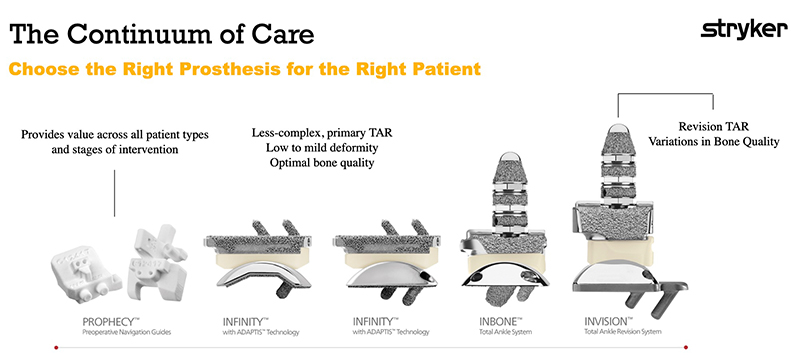
Image courtesy of www.stryker.com
When a replacement is the right operation
End-stage ankle arthritis means the cartilage between the shin bone and the talus has worn away, leaving bone rubbing against bone. It causes pain with every step, stiffness, and swelling that no longer settles with rest, bracing, injections, or anti-inflammatories.
Total ankle replacement removes the damaged surfaces and resurfaces them with metal components and a plastic bearing. Unlike fusion, which relieves pain by eliminating movement at the joint, a replacement is intended to relieve pain while preserving the ankle's motion — which is why it tends to feel more natural walking, and why it places less strain on the joints above and below it over time.
Replacement or fusion?
Both operations reliably relieve arthritis pain, and the right choice depends on your alignment, bone quality, ligament stability, activity demands, and what you want your ankle to do afterward. That conversation is worth having in person, with your imaging in front of you.
What the operation involves
The procedure is performed under anesthesia through an incision at the front of the ankle. The worn surfaces of the tibia and talus are removed precisely, the implant components are placed, and alignment is checked before closure.
If your ankle sits in poor alignment, or if a tight calf or a deformity elsewhere in the foot is contributing, those are addressed at the same time. A replacement placed into a crooked foot will not last.
Recovery
You will be in a splint and off the foot initially, then move into a walking boot as the wound heals and swelling settles. Physical therapy focuses on restoring motion early and rebuilding strength and balance as weight bearing progresses.
Most people are walking in a regular shoe well before they feel fully recovered; swelling and stamina continue to improve for the better part of a year. You will receive a written post-operative protocol setting out each stage, and Dr. Williams follows ankle replacements long-term with periodic X-rays.