

Ankle Ligament Reconstruction
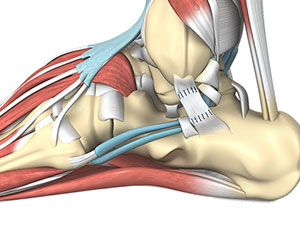
Why an ankle keeps giving way
Most ankle sprains heal. Some do not. When the ligaments on the outside of the ankle — the anterior talofibular ligament and the calcaneofibular ligament — heal stretched out rather than tight, the ankle loses its restraint. What follows is chronic instability: repeated sprains, a sense that the ankle is about to roll on uneven ground, and a growing reluctance to trust it.
Left alone, an unstable ankle does more than sprain repeatedly. Each episode loads the cartilage abnormally, and over years that pattern contributes to arthritis. Restoring stability is as much about protecting the joint as it is about stopping the sprains.
What comes before surgery
Physical therapy is the first treatment, and it works for many people — strengthening the peroneal tendons and retraining balance can compensate for a good deal of ligament laxity. Bracing helps during activity. Surgery is considered when instability persists despite a genuine course of therapy, or when the ankle is giving way in daily life rather than only in sport.
The operation
Ligament stabilization is usually done together with ankle arthroscopy, and that pairing matters. Before the ligaments are addressed, a camera is placed into the joint through two small portals to look at the cartilage directly. Years of instability frequently leave findings inside the joint — cartilage damage on the talus, loose fragments, scar tissue causing impingement — and these are treated at the same sitting. Repairing the ligaments while leaving a cartilage lesion behind is a common reason an otherwise good operation disappoints.
The ligaments themselves are then tightened and reattached to the fibula, restoring the anatomy rather than substituting for it, and reinforced with the strong tissue overlying the repair. Where the ligament tissue is poor, where there is generalized laxity, or where a previous repair has failed, the repair may be augmented or reconstructed with graft.
Recovery
The ankle is protected in a splint for the first two weeks with no weight on it, which gives the repair time to take. From roughly two to six weeks you move into a walking boot and progress to full weight bearing, working on ankle range of motion and swelling control.
Between six and nine weeks you transition from the boot to a lace-up brace and then to a regular shoe, with strengthening, balance and proprioception work, and attention to walking mechanics — gait often needs retraining after time in a boot. From around nine weeks, activity advances as tolerated. Return to cutting and pivoting sport is later still, and is guided by how the ankle performs rather than by the calendar.
Risks and Complications
Risks and complications associated with ankle ligament reconstruction include:
- Infection
- Nerve damage
- Blood clots
- Persistent instability or stiffness
- Recurrent sprains
- Pain and swelling
- Anesthesia risks