

If your injury just happened
TRIA offers walk-in orthopedic urgent care at 8100 Northland Dr in Bloomington, the same building as Dr. Williams's office. No appointment is needed and it is open seven days a week. If you have had a sudden injury and are not sure whether it needs an X-ray, that is usually the fastest way to get an answer, and you will be seen by a musculoskeletal specialist. Check current urgent care hours, then call (952) 831-8742 to arrange follow-up with Dr. Williams.
Ankle Sprain
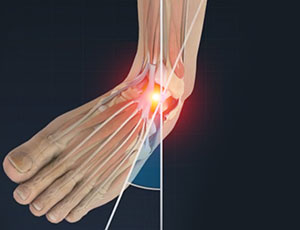
What happens in a sprain
An ankle sprain is a ligament injury, not a bone injury. Most happen when the foot rolls inward underneath the leg, stretching or tearing the ligaments on the outside of the ankle — usually the anterior talofibular ligament first, and with greater force the calcaneofibular ligament as well. Pain, swelling, and bruising on the outside of the ankle follow within hours.
How sprains are graded
Sprains are described by how much ligament damage occurred: fibres stretched with the joint still stable, partial tearing with some looseness, or complete rupture leaving the ankle unstable. The grade guides how long the ankle needs protecting, but early treatment is broadly similar across all three.
Treatment
In the first days, the priorities are protection and swelling control — a brace or boot, ice, compression, and elevation, with weight bearing as pain allows. Controlled early motion and loading produce better results than prolonged immobilization in a cast.
After that, rehabilitation does the real work: restoring motion, strengthening the peroneal tendons that guard against the ankle rolling, and retraining balance. That last part is what prevents the next sprain, and it is the part most often skipped once the pain settles.
When a sprain needs more than rehabilitation
Most sprains recover. If yours is still painful and swollen around six weeks on, or the ankle keeps giving way, that is worth investigating rather than waiting longer. The usual explanations are a cartilage lesion on the talus, a peroneal tendon tear, a fracture missed on the first X-ray, or ligaments that healed loose — which is chronic ankle instability.