

Arthroscopic Ankle Joint Cartilage Repair
What Is Arthroscopic Ankle Joint Cartilage Repair?
Cartilage damage in the ankle rarely announces itself. It usually starts with an injury — often a sprain, sometimes years earlier — and shows up later as a deep ache inside the joint, swelling that returns with activity, and occasionally catching or a sense that the ankle is giving way. Because cartilage has almost no blood supply, these defects do not fill in on their own.
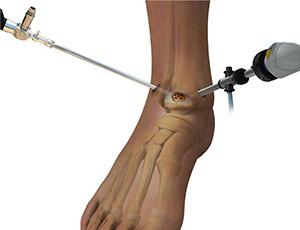
- Arthroscopic ankle joint cartilage repair is a minimally invasive surgical procedure used to treat damage to the cartilage inside the ankle joint. The surgery is performed through small incisions using an arthroscope, allowing your surgeon to evaluate and repair cartilage damage without the larger incisions required in traditional open surgery.
- An arthroscope is a thin, fiber-optic instrument equipped with a light source and camera. Images from inside the ankle joint are displayed on a monitor, enabling the surgeon to precisely identify the damaged cartilage, assess the severity of the injury, and perform the necessary repair while minimizing disruption to surrounding tissues.
Anatomy of the Ankle Joint
- The ankle joint connects the lower leg to the foot and allows for smooth, controlled movement. It is formed by the tibia and fibula (leg bones) articulating with the talus (ankle bone). The ends of these bones are covered with articular cartilage, a smooth, white tissue that cushions the joint and allows bones to glide easily during movement.
- Because cartilage has very limited blood supply, it has little ability to heal on its own once injured. Damage can occur due to trauma, repetitive stress, or normal wear over time. When cartilage is damaged, the joint surfaces no longer move smoothly, which can lead to pain, swelling, stiffness, and inflammation.
Indications for Arthroscopic Ankle Joint Cartilage Repair
-
This procedure is typically recommended when non-surgical treatments—such as bracing, physical therapy, activity modification, anti-inflammatory medications, or steroid injections—have failed to relieve symptoms. Advanced imaging studies, such as MRI or CT scans, are usually obtained to evaluate the extent of cartilage damage and determine whether surgery is appropriate.
Benefits of Arthroscopic Cartilage Repair
-
Arthroscopic ankle cartilage repair aims to relieve pain, restore joint function, and improve mobility. Compared to open surgery, arthroscopy generally allows for smaller incisions, less postoperative pain, faster recovery, and fewer complications. In many patients, this procedure may delay or eliminate the need for more extensive surgeries in the future, such as ankle fusion or total ankle replacement.
Preparation for Arthroscopic Ankle Joint Cartilage Repair
Preparation for arthroscopic ankle joint cartilage repair may involve the following steps:
-
A review of your medical history and physical examination is performed to check for any medical issues that need to be addressed prior to the procedure.
- You may also need to undergo diagnostic tests such as blood work to help detect any abnormalities that could compromise the safety of the procedure and imaging of the foot and ankle to plan the procedure.
- You will be asked if you have allergies to medications, anesthesia, or latex.
- You should inform your doctor of current medications or supplements you are taking, or any recent illnesses or conditions you have such as a heart or lung disease.
- Your physician may alter the dosage of your medications or ask you to stop taking certain medications, such as blood thinners for a defined period if contraindicated for the procedure.
- You should refrain from alcohol and tobacco for at least a few days prior to surgery and several weeks after, as these can hinder the healing process.
- You should not consume any solids or liquids at least 8 hours prior to the surgery.
- You should arrange for someone to drive you home after the procedure.
- A signed informed consent form will be obtained from you after the pros and cons of the surgery have been explained.
Procedure for Arthroscopic Ankle Joint Cartilage Repair
Surgical treatment is dependent on the nature and severity of the cartilage damage. In general, arthroscopic ankle joint cartilage repair is performed by a foot and ankle surgeon under general or regional anaesthesia and involves the following steps:
- You will be placed on the procedure table in a position that offers the best possible angle for your surgeon to perform the ankle joint cartilage repair.
- Two to three small surgical incisions called portals are made on the front of the ankle, and the joint is inflated with sterile saline solution so that the structures of the joint can be clearly seen with the arthroscope.
- An arthroscope is inserted through one of the portals to provide images of the joint on the monitor for your surgeon to view the inside of your ankle. The entire joint will be inspected to evaluate damage to the cartilage.
- Specialized miniature instruments are then introduced into the joint through other portals to repair the damaged cartilage or stimulate new cartilage growth.
- The most common minimally invasive ankle cartilage repair surgery is called the microfracture procedure in which your surgeon removes damaged cartilage and drills small holes into the ankle bone to stimulate new cartilage growth.
- The other method involves replacement of the damaged cartilage in which the damaged cartilage is entirely removed, and the site is prepared for placing a cartilage graft of donor tissue.
- Once satisfactory ankle joint cartilage repair is confirmed, the scope and the instruments are withdrawn, and the wound is closed with sterile bandages.
Postoperative Care and Recovery
In general, postoperative care instructions and recovery after arthroscopic ankle joint cartilage repair will involve the following steps:
- You will be transferred to the recovery area where your nurse will closely observe you for any allergic/anesthetic reactions and monitor your vital signs as you recover.
- The treated ankle will be immobilized with the help of splints and a bulky dressing. You are advised not to bear weight on the ankle for at least 6 weeks and use crutches for walking.
- You may notice pain and swelling in the ankle area. Swelling and discomfort can be managed with prescription pain medicines, applying ice packs, and elevating your ankle above heart level while resting.
- Antibiotics may also be prescribed to address the risk of surgery-related infection.
- An individualized physical therapy regimen will be started once you are off crutches to strengthen your foot and ankle muscles and optimize joint function.
- Instructions on surgical site care and bathing will be provided to keep the wound clean and dry.
- Refrain from strenuous activities for at least 6 months. A gradual increase in activities is recommended, with your doctor’s guidance.
- A periodic follow-up appointment will be scheduled to monitor your progress.
Benefits of Arthroscopic Ankle Joint Cartilage Repair
Some of the benefits of arthroscopic ankle joint cartilage repair over traditional open ankle surgery include:
- Smaller incisions
- Minimal muscle trauma
- Smaller scars
- Minimal blood loss
- Lower risk of infection
- Less postoperative pain
- Shorter hospital stay
- Faster recovery
- Lower risk of complications associated with open surgery
Which technique?
Which repair suits you depends on the size of the defect, whether the bone underneath is involved, and whether this is a first procedure or a revision. Smaller, contained lesions are often treated by preparing the bone beneath the defect so that marrow cells reach the surface and form repair tissue. Larger lesions, or ones that have already failed a first attempt, may need a scaffold or graft to build on — including BioCartilage regeneration.
Dr. Williams will discuss which approach fits your lesion once he has reviewed your imaging.
Risks and Complications
Arthroscopic ankle joint cartilage repair surgery is a relatively safe procedure; however, as with any surgery, some risks and complications may occur, such as the following:
- Infection
- Bleeding
- Postoperative pain
- Damage to surrounding structures
- Stiffness or restricted joint motion
- Blood clots or deep vein thrombosis (DVT)
- Adverse reactions to anesthesia