

BioCartilage Regeneration
The problem it addresses
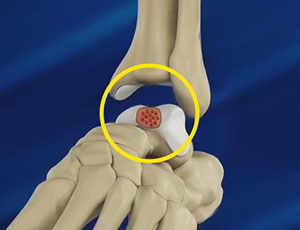
Cartilage is the smooth surface that lets the bones of your ankle glide against each other. When a piece of it is damaged — usually by an injury, sometimes years earlier — the defect does not fill back in on its own. Cartilage has almost no blood supply, and the body cannot regrow it the way it heals bone. What is left is a bare patch on the talus that causes deep ankle pain, catching, and swelling that returns with activity.
What the procedure does
The traditional approach, microfracture, makes tiny openings in the bone beneath the defect so that marrow cells reach the surface and form a repair tissue. That tissue works, but it is fibrocartilage — tougher and less durable than the hyaline cartilage it replaces.
BioCartilage is a way of improving what forms in that space. It is donated human cartilage that has been dried and ground into a fine powder, retaining the natural scaffolding of real cartilage. During arthroscopy, the defect is prepared with microfracture, then the powder — mixed with a concentrate of your own platelets — is pressed into the defect and sealed with a fibrin adhesive. It gives the healing cells a structure to build on rather than leaving them to fill an empty crater.
Who it suits
It is considered for cartilage lesions of the talus that have well-defined edges and remain painful after non-surgical treatment. It is not a treatment for widespread ankle arthritis, where the cartilage is worn across the whole joint — that is a different problem, and a different conversation.
Recovery
The repair needs protection while it matures. You will be off the foot for a period after surgery, then progress through a boot as weight bearing is allowed, with early motion encouraged throughout because motion nourishes healing cartilage.
Returning to impact activity is deliberately slow — the tissue continues to mature for months after you feel well — and your written protocol will set out each stage.
Risks and Complications
BioCartilage regeneration surgery is a relatively safe procedure; however, as with any surgery, some risks and complications may occur, such as the following:
- Infection
- Bleeding
- Postoperative pain
- Damage to surrounding structures
- Stiffness or restricted joint motion
- Blood clots or deep vein thrombosis (DVT)
- Adverse reactions to anesthesia