

If your injury just happened
TRIA offers walk-in orthopedic urgent care at 8100 Northland Dr in Bloomington, the same building as Dr. Williams's office. No appointment is needed and it is open seven days a week. If you have had a sudden injury and are not sure whether it needs an X-ray, that is usually the fastest way to get an answer, and you will be seen by a musculoskeletal specialist. Check current urgent care hours, then call (952) 831-8742 to arrange follow-up with Dr. Williams.
Lisfranc (Midfoot) Injury
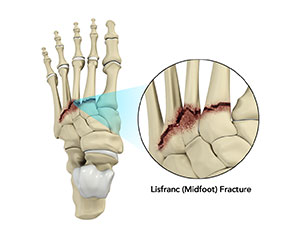
What the Lisfranc joint is
The Lisfranc joint is where the long bones of the forefoot meet the smaller bones of the midfoot. It is not a joint that moves much; its job is to hold the arch rigid so the foot can act as a lever when you push off. A strong ligament runs across it from the medial cuneiform to the base of the second metatarsal — the Lisfranc ligament — and it is the keystone of that arrangement.
How the injury happens
Two patterns. A high-energy injury such as a motor vehicle collision or a fall causes obvious fracture and dislocation. The subtler pattern — and the one that gets missed — is a twist or a load applied to a foot that is pointed down, which happens in football, in a stumble on stairs, or in a fall from a kerb.
Why it is missed
This is the important part. A subtle Lisfranc injury looks like a bad midfoot sprain. The patient can often still walk. Standard X-rays taken lying down may appear entirely normal, because the bones only separate when the foot is loaded.
The findings that should prompt further imaging are bruising on the sole of the midfoot, which is close to specific for this injury; pain across the middle of the foot that is disproportionate to a simple sprain; and inability to push off or rise onto the toes.
Weightbearing X-rays of both feet for comparison are the key test, with CT or MRI added when doubt remains. A missed Lisfranc injury leads to collapse of the arch and midfoot arthritis, and reconstructing it later is considerably more difficult than treating it at the time.
Treatment
A genuinely stable injury with no displacement can be treated without surgery, in a boot with a period of no weight bearing, and followed with repeat weightbearing X-rays to confirm it has not shifted.
Any displacement, however small, is treated surgically. The bones are returned to their anatomic position and held there — with screws or plates, or by fusing the affected joints where the cartilage is destroyed or the injury is primarily ligamentous. Because the Lisfranc joints move very little to begin with, fusing them is well tolerated.
Recovery
Recovery is longer than most people expect. Anticipate a period with no weight on the foot, then a graded return in a boot, and a gradual progression to normal shoes over months. Swelling and stiffness across the midfoot persist well into the first year. You will receive a written protocol covering each stage.