

Plantar Fasciitis
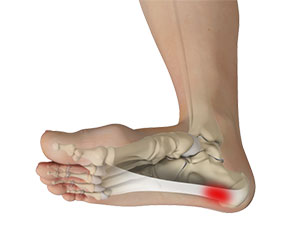
What the plantar fascia does
The plantar fascia is a thick band of tissue running from the heel bone to the base of the toes along the sole of your foot. It works like a bowstring, holding up the arch and storing energy as you push off. Every step loads it.
How it presents
The hallmark is pain under the heel with the first steps in the morning, or after any period of sitting. It eases within a few minutes of walking, then returns later in the day or after standing for a long time. Pressing the inner side of the heel bone reproduces it precisely.
The pain comes from degeneration and micro-injury where the fascia attaches to the heel, not from inflammation in the usual sense — which is part of why anti-inflammatory tablets alone rarely resolve it.
What causes it
A sudden increase in walking, running, or standing is the most common trigger. A tight calf is the most important contributing factor: when the ankle cannot bend far enough, load transfers into the fascia instead. Unsupportive shoes, hard floors, and weight gain all add to it.
Heel spurs are frequently blamed and are usually innocent. Many people with spurs have no pain, and many people with plantar fasciitis have no spur. Removing a spur is almost never the answer.
Treatment
Around nine in ten cases resolve without surgery, but it takes months rather than weeks — expect improvement to be gradual, and do not read slow progress as failure.
Calf stretching and plantar fascia stretching, done daily and kept up long after the pain settles, are the core of treatment. Supportive shoes with a cushioned heel, over-the-counter or custom inserts, and a night splint for the morning pain all help. Rolling the sole over a frozen bottle relieves symptoms. Activity is modified rather than stopped, and physical therapy addresses the mechanics behind it.
A cortisone injection can settle severe pain that is preventing you from doing the stretching, though it is used sparingly — repeated injections weaken the fascia. Surgery is considered only in the small minority whose pain persists after a year of consistent treatment.
When it isn't plantar fasciitis
Pain that burns or tingles, that persists at rest or wakes you at night, or that came on suddenly with rapidly worsening pain on every step points elsewhere — nerve irritation or a stress fracture of the heel bone. Both are worth ruling out if the picture does not fit. See heel pain for how the location of the pain narrows the diagnosis.
Risk factors include:
- Obesity
- Foot arch problems such as flat feet or high arches
- Activities such as long-distance running, ballet and dance aerobics
- Occupations that necessitate walking or standing on hard surfaces for a long period
- Wearing thin-soled shoes or shoes with poor arch support