

If you need to be seen sooner
TRIA offers walk-in orthopedic urgent care at 8100 Northland Dr in Bloomington, the same building as Dr. Williams's office. No appointment is needed and it is open seven days a week. If your pain is getting worse, or you cannot put weight through the foot, that is usually the fastest way to get an X-ray and an answer. Check current urgent care hours, then call (952) 831-8742 to arrange follow-up with Dr. Williams.
Stress Fractures of Foot and Ankle
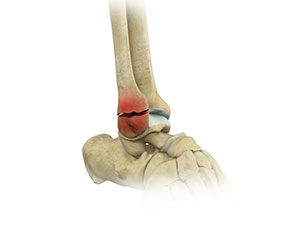
A fracture without an injury
A stress fracture is a crack that develops in bone from repeated loading rather than from a single injury. Bone is living tissue that continuously remodels itself; when the load applied outpaces the rate at which it can rebuild, small areas of damage accumulate and eventually form a fracture line.
There is no moment of injury to remember. Instead the pain builds over days or weeks, starts late in an activity, then starts earlier and earlier, and eventually is present walking and at rest.
Where they occur
In the foot and ankle, the metatarsals are the most common site, followed by the heel bone, the navicular in the midfoot, and the lower tibia and fibula. The distinguishing feature on examination is tenderness at one precise point on the bone, rather than spread over an area.
The ones that need more caution
Most stress fractures heal reliably with rest. A few are considered high-risk because their blood supply is poor or they sit where the bone is under tension — the navicular, the base of the fifth metatarsal, the front of the tibia, and the medial malleolus. These heal slowly, may fail to heal at all, and are more likely to be treated with a period of no weight bearing or with surgical fixation.
Why they happen
The usual cause is a change in training load: more mileage, more intensity, a new surface, or a return after time off. Beyond training, the contributors worth taking seriously are inadequate energy intake relative to activity, low vitamin D, low bone density, menstrual irregularity in female athletes, and foot shape that concentrates load on one area.
A stress fracture in someone who has not changed their training, or a second one, is a reason to look at bone health rather than only at the bone that broke.
Diagnosis
X-rays are frequently normal in the first weeks — a stress fracture often only becomes visible once healing bone forms around it. A normal X-ray does not exclude the diagnosis. MRI detects them early and is the test of choice when the history and examination are suggestive.
Treatment
Most are treated by removing the load that caused them: a boot or stiff-soled shoe, reduced or modified activity, and cross-training to maintain fitness. Healing typically takes six to eight weeks, and returning to full training is graded rather than immediate — going back at the previous volume is the common way a stress fracture recurs.
High-risk fractures, fractures that have failed to heal, and athletes who need a reliable return to sport may be treated surgically, usually with a screw across the fracture. Alongside that, correcting the underlying cause — training progression, nutrition, vitamin D, bone density, footwear — is what prevents the next one.