

Tarsal Coalition
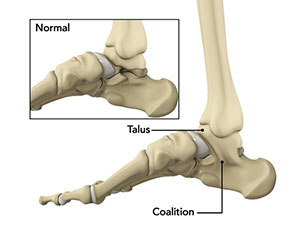
What a coalition is
A tarsal coalition is an abnormal connection between two bones in the back of the foot that should move independently of each other. The bridge may be bone, cartilage, or fibrous tissue. It is present from birth, though it is not usually noticed then — it becomes symptomatic later, as the connection stiffens with growth.
The two common types join the heel bone to the navicular, or the heel bone to the talus. Coalitions affect both feet in a substantial proportion of people who have one.
How it presents
Symptoms typically begin in the early teens, as the coalition matures and the foot becomes progressively less able to adapt. The usual picture is a stiff, flat foot with aching pain in the hindfoot after activity, difficulty on uneven ground, and repeated ankle sprains — because a foot that cannot tilt at the hindfoot transfers that demand to the ankle instead.
Many people are told for years that they simply have flat feet. What distinguishes a coalition is the stiffness: the hindfoot does not move much when tested, and the arch does not reappear when standing on tiptoe.
Diagnosis
X-rays including oblique views can show a bony bridge and the secondary changes it causes. CT is the best test for defining a bony coalition and its extent; MRI is better for cartilaginous or fibrous bridges, which do not show on X-ray at all. Knowing how much of the joint is involved, and whether there is arthritis already, is what determines treatment.
Treatment
Non-surgical treatment is tried first and often works, particularly during a symptomatic flare. Activity modification, a period of immobilization in a boot or cast to settle the irritation, custom orthotics or bracing to support the hindfoot, physical therapy for calf flexibility, and anti-inflammatories all have a role.
Surgery is considered when pain persists. Where the coalition is small and the surrounding joints are healthy, it can be resected — removed, with tissue interposed to stop it reforming — which preserves motion. Where the coalition is extensive, where arthritis has already developed, or where the foot sits in significant deformity, fusion of the affected joint gives more reliable relief, and any deformity is corrected at the same time.
What to expect afterwards
The goal is a foot that is comfortable and can tolerate activity, not a foot with normal flexibility — some stiffness generally remains. Recovery involves a period of protected weight bearing followed by therapy, and you will receive a written protocol setting out the stages.