

If your injury just happened
TRIA offers walk-in orthopedic urgent care at 8100 Northland Dr in Bloomington, the same building as Dr. Williams's office. No appointment is needed and it is open seven days a week. If you have had a sudden injury and are not sure whether it needs an X-ray, that is usually the fastest way to get an answer, and you will be seen by a musculoskeletal specialist. Check current urgent care hours, then call (952) 831-8742 to arrange follow-up with Dr. Williams.
Achilles Tendon Rupture
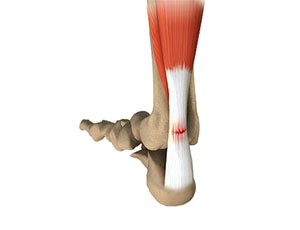
What a rupture feels like
The Achilles is the largest and strongest tendon in the body, connecting the calf muscles to the heel bone. When it ruptures, it usually does so suddenly during a push-off or a change of direction. The classic description is of being struck or kicked in the back of the leg — many people turn around to see who did it — followed by a pop, sudden weakness, and the inability to push off.
Walking is often still possible, which is exactly why the injury is sometimes missed. What is not possible is rising onto the toes on that leg alone.
Who it happens to
Ruptures are most common in active people in their thirties to fifties returning to sport after a period away, particularly in activities with sudden acceleration. Tendon that has been quietly degenerating for years often tears during an entirely ordinary movement.
Diagnosis
Examination is usually enough. A palpable gap in the tendon and the absence of the normal calf-squeeze response are reliable findings. Imaging is used when the diagnosis is unclear, when presentation is delayed, or when planning surgery for an older rupture.
Treatment
An Achilles rupture can be treated without surgery or with surgical repair, and both are legitimate. Non-surgical treatment holds the ankle pointed down in a boot or cast so the torn ends sit together and heal, then follows the same graded rehabilitation. Repair is generally favoured for younger and more active patients, for those whose work or sport demands full push-off strength, for delayed presentations, and for re-ruptures.
Whichever route is taken, the recovery is measured in months and the pace matters. Advancing too quickly is the most common cause of re-rupture, and the eccentric calf strengthening late in rehabilitation is what restores real push-off power.
Getting seen quickly
If you suspect a ruptured Achilles, arrange to be seen promptly. Treatment decisions are more straightforward and the results are better when the injury is addressed early, before the torn ends have drawn apart.