

If your injury just happened
TRIA offers walk-in orthopedic urgent care at 8100 Northland Dr in Bloomington, the same building as Dr. Williams's office. No appointment is needed and it is open seven days a week. If you have had a sudden injury and are not sure whether it needs an X-ray, that is usually the fastest way to get an answer, and you will be seen by a musculoskeletal specialist. Check current urgent care hours, then call (952) 831-8742 to arrange follow-up with Dr. Williams.
Foot Fracture
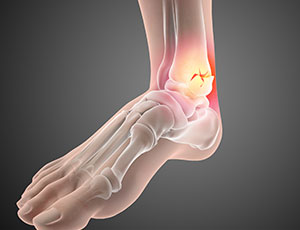
The foot is not one bone
There are twenty-six bones in each foot, and where a fracture sits matters more than the fact of the break. Treatment and recovery differ enormously between one part of the foot and another.
Toe fractures are common and usually treated by taping the toe to its neighbour and wearing a stiff-soled shoe. The exception is the big toe, which carries far more load and is taken more seriously.
Metatarsal fractures in the middle of the foot often heal well in a boot if they are not displaced. The fifth metatarsal is the exception worth knowing about: fractures at its base near the midfoot have a poor blood supply, heal slowly, and in athletes are frequently fixed with a screw rather than treated in a boot.
Midfoot fractures, particularly around the Lisfranc joint, are the ones most often missed and the ones where a missed diagnosis costs the most.
Heel bone fractures usually follow a fall from height. They involve the joint surface, cause dramatic swelling, and are among the more demanding injuries in the foot to treat.
Talus fractures are uncommon and serious. The talus has a precarious blood supply, so these fractures need careful, prompt treatment.
Diagnosis
X-rays in several views come first, taken weightbearing where possible, since some injuries only reveal themselves under load. CT is used when the fracture involves a joint surface or when the anatomy is complex — the heel bone, the talus, and the midfoot in particular.
Treatment
Fractures that are in good position and stable are treated with protection: a stiff-soled shoe, a boot, or a cast, with weight bearing determined by which bone is broken. Repeat X-rays confirm that the position holds.
Surgery is used when fragments are displaced, when a joint surface is involved, when the foot would otherwise heal out of alignment, or when the fracture is one known to heal poorly on its own. Fixation uses screws, plates, or wires depending on the bone.
Recovery
Timelines vary widely by location — a toe fracture may need a few weeks in a stiff shoe, while a heel bone fracture involves months of protected weight bearing. Swelling in the foot is stubborn and improves over many months; elevation early makes a real difference. You will receive a written protocol specific to your fracture.
Why a fracture that heals crooked matters
The foot works as a tripod, and its bones distribute load in a specific pattern. A fracture that heals out of position redirects that load, which causes callus, difficulty with shoes, and arthritis in joints taking more than their share. That is why some fractures that would heal perfectly well left alone are still worth fixing.